SEO for hotels in Ibiza isn't about outranking Booking.com for "Ibiza hotel". That search belongs to the OTAs, comparison sites and big travel publishers, and a boutique hotel doesn't need to fight for it. It's about showing up on Google when someone searches your name, your area, your type of property or the exact occasion they're travelling for, and making sure that visit ends in a direct booking on your own site rather than on an OTA.
This guide covers the searches you can realistically win, the pages your website needs, the technical basics you can't skip and how to earn local links and content without tricks Google penalises.
Which searches a boutique hotel can actually win
Not every search is worth the same, and not every one is within reach. For an independent hotel or agroturismo on the island, it helps to split them like this:
| Search type | Example | What it takes to compete |
|---|---|---|
| Your brand | "your hotel name", "your hotel name reviews" | A clear website, a well-kept Business Profile and free booking links |
| Area and type | "agroturismo north Ibiza", "boutique hotel Santa Eulalia" | A page dedicated to your area and type of property |
| Occasion | "Ibiza honeymoon hotel", "yoga retreat Ibiza" | Occasion pages with a real offer, photos and prices |
| Features | "adults-only hotel Ibiza with spa" | Content that shows what you have rather than just claiming it |
| Informational | "Ibiza in winter", "best coves near San Antonio" | Useful guides written by people who know the area |
| Generic | "Ibiza hotel" | Years of authority and budget; not your first target |
To decide where to start, open Search Console. The Performance report shows which queries you already appear for, with impressions and countries. Often the best opportunity is a search where you're already on page two. Watch the place names too: English-speaking guests may well search with Spanish or anglicised forms such as Santa Eulalia, San Antonio or Ibiza Town, while signs and official sites use Santa Eulària, Sant Antoni and Eivissa. Check which forms your visitors actually use and write your English pages to match, mentioning the official name naturally alongside.
The pages your hotel website needs
A hotel site with a beautiful homepage and little else has very little to rank: Google can't show pages that don't exist. A structure that works:
- Homepage: who you are, where you are and who the hotel is for, with the booking button always visible.
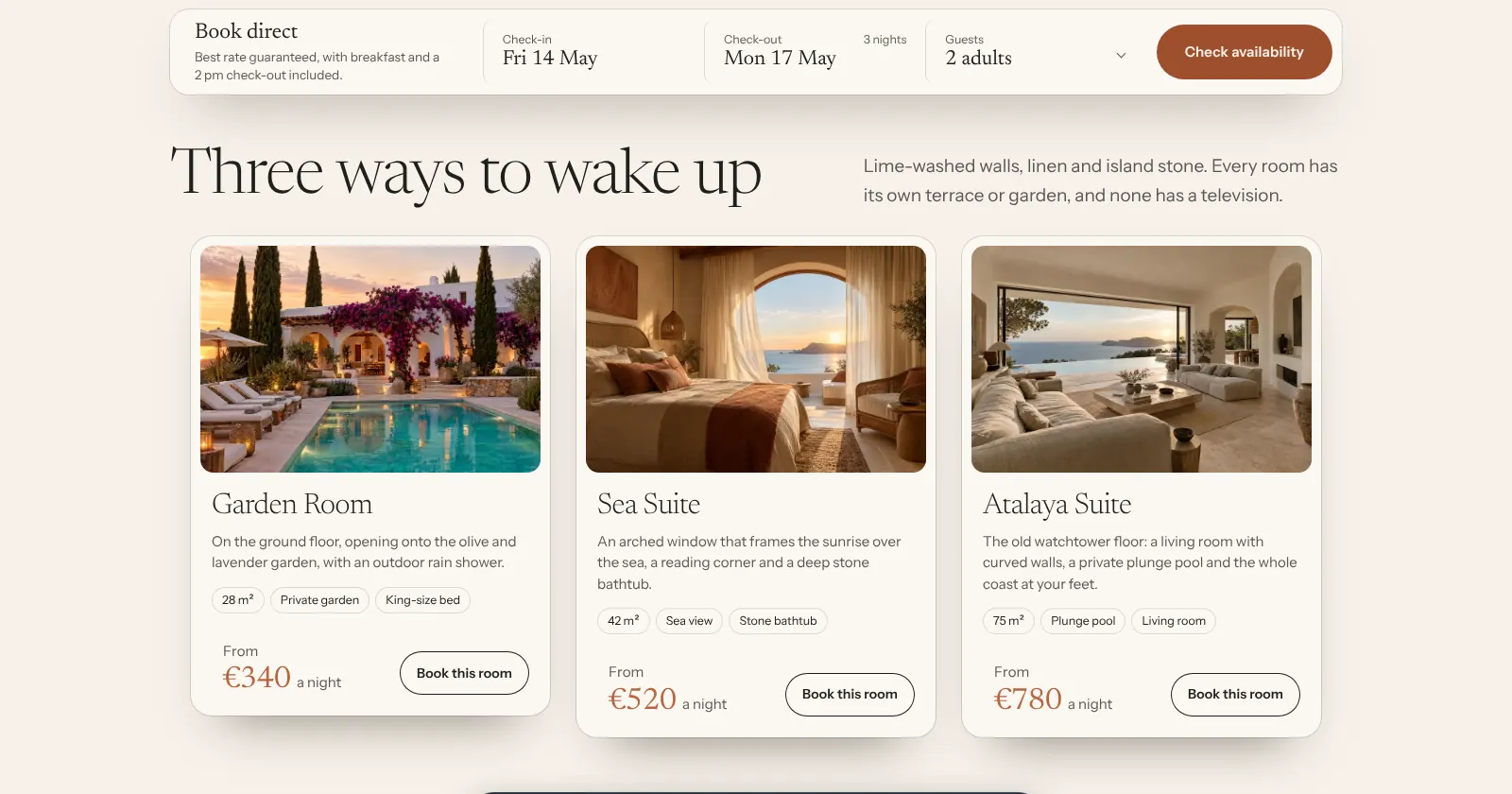
- One page per room or suite type with your own photos, size, views, beds and a guide price.
- Location and getting here: distance to the airport, Ibiza Town and the nearest coves; parking and transfers.
- Occasion pages: weddings, honeymoons, retreats, groups, long stays.
- Seasonal packages, including autumn and winter if you open.
- A local guide written by your team: restaurants, coves, walks, markets and what's open when.
Before publishing each page, run through this:
- A unique SEO title that includes what people search for and your area, not the same title on every page.
- A clear H1 and copy written for people, not keyword lists.
- Your own optimised photos, with descriptive alt text and file sizes that don't slow the page.
- Internal links between related pages: from the suite to the weddings page, from the local guide to location.
- A booking or WhatsApp button on every page, not just the homepage.
- An equivalent version in each language, linked with hreflang.
- No filler pages: if you have no spa, don't write a page targeting "Ibiza hotel with spa".
The technical basics you can't skip
Hotel sites tend to carry heavy photography, video and a third-party booking engine, and it all adds weight. If your site is slow on mobile you lose rankings and bookings at the same time; we explain why in why a slow website doesn't show on Google. Beyond speed:
- Structured data. Google asks you to use the most specific LocalBusiness subtype possible; for you, Hotel or the relevant lodging type, with name, address, phone number in international format, coordinates and URL.
- Seasonal closure. Opening hours markup accepts validity dates, handy if you close for winter, so your data doesn't contradict reality.
- Reviews in markup. Google's documentation reserves rating and review properties for sites that collect reviews about other businesses. Don't mark up your own reviews to chase stars.
- Languages. One URL per language, reciprocal hreflang and no unedited machine translation; our guide to multilingual websites for Ibiza hotels and restaurants walks through it.
- Site changes. A redesign without redirects can wipe out years of rankings. If you're planning one, follow our checklist for a website redesign without losing SEO.
Local SEO: the map is Google too
For many hotel searches, Google shows a map of places to stay before the usual results. According to Google's own help, local results depend mainly on relevance, distance and prominence, meaning how well known your business is, which draws on the sites linking to you and on how many reviews you have and how they're rated. Keep your name, address and phone number identical on your website, your Business Profile and any directories, reply to every review and connect your rates so your site appears as a booking option. We go deeper in our guide to Google Hotel Ads and Business Profile for Ibiza hotels.
Local content and links, no tricks
A boutique hotel's edge over an OTA is that it genuinely knows the island. Use it: a guide to the nearby coves with practical details, which restaurants stay open in winter, how to get around without a car from your area, how to do Formentera in a day. That content answers real questions, attracts links and gives people reasons to come back to your site. Winter is the time to write it: one solid guide a month from November to March gives you a small library of pages that are already indexed by the time guests start planning their summer, written while your team has time to do it properly.
The links worth having are the ones that would make sense even if Google didn't exist: the restaurant you partner with, the wedding planner who works with you, the instructor who runs retreats at your hotel, local press and travel media that mention you. Google's spam policies treat buying links for ranking, or excessive link exchanges, as manipulation, so steer clear of cheap link packages.
SEO doesn't deliver overnight and nobody credible can guarantee rankings, but every well-built page keeps working season after season with no commission attached. To see how it fits with the rest of your strategy, take a look at our approach to hotel marketing in Ibiza.
Frequently asked questions
Can a small Ibiza hotel outrank Booking.com on Google?
For generic searches like 'Ibiza hotel', it's very hard. For your brand, area-and-type searches, occasion searches and informational searches about your surroundings, it's realistic, because there being specific and useful counts for more than being big.
How long does hotel SEO take to work?
It depends on the competition, the state of your site and how much you publish, and nobody can honestly guarantee timescales or rankings. The practical approach is to do the work in winter so pages are indexed and settled before guests plan the following season.
Should my hotel website use structured data?
Yes. Use the most specific LocalBusiness subtype, such as Hotel, with name, address, phone, coordinates and URL. If you close in winter, add validity dates to your opening hours. Don't mark up your own reviews to get stars: Google reserves that markup for sites reviewing other businesses.
Is a blog worth it on a hotel website?
Yes, if it answers questions your guests actually ask: nearby coves, what's open in winter, getting around, ideas for specific occasions. Generic posts about Ibiza that already exist on a hundred sites won't rank; what ranks is what only your team can tell.
Sources
Want more direct bookings for your hotel?
We'll give you a free strategy analysis of your business and tell you honestly what we would do, no obligation.