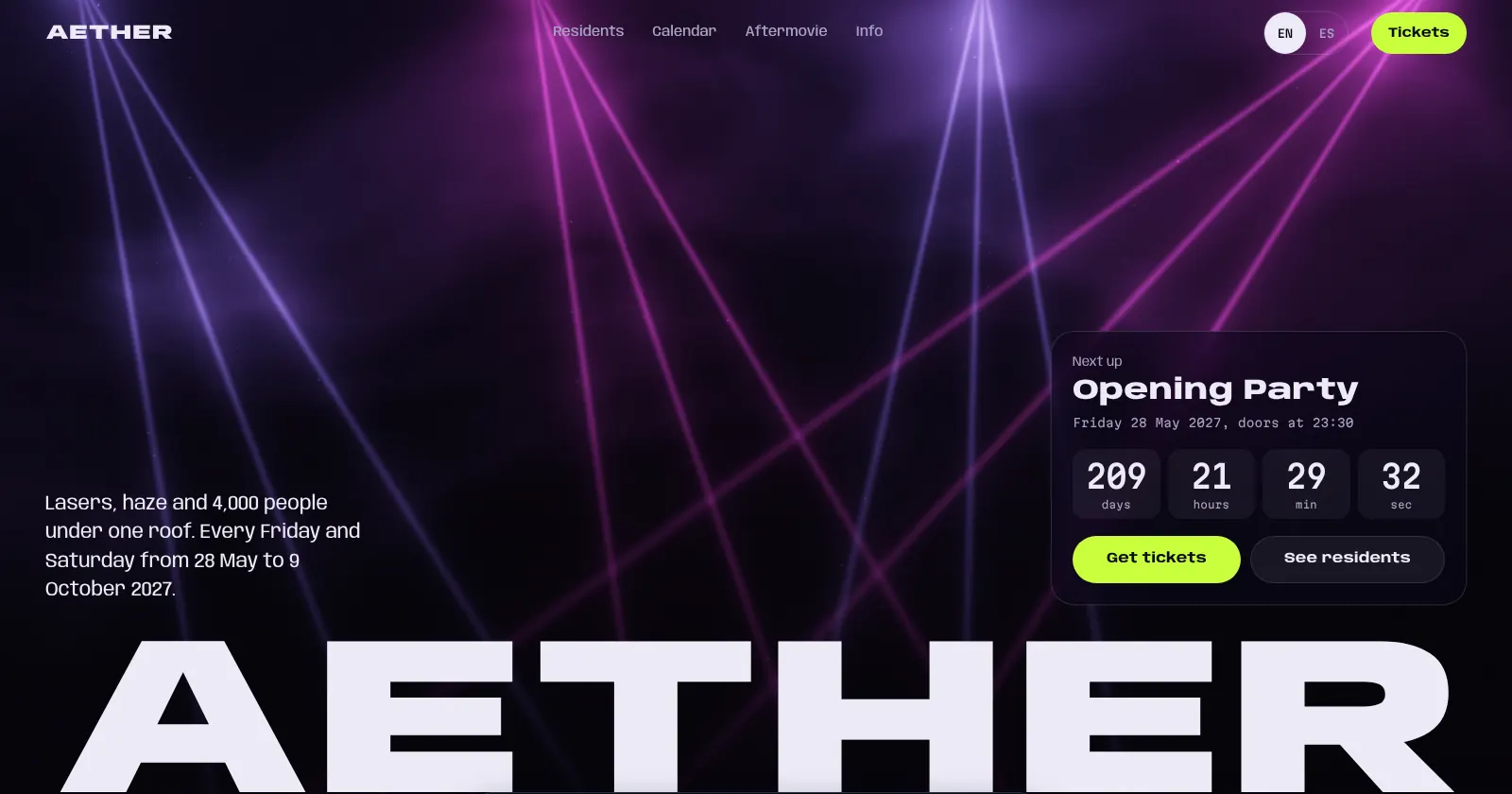
Plenty of clubs have a stunning website that sells very little: a full-screen video, the season's poster and a button that sends people to another site where they get lost. A nightclub website that sells tickets is designed the other way round. The buying journey comes first, working on a phone, in at least two languages and in as few steps as possible; the visual experience comes second.
This guide covers the pieces you need: event pages, ticketing integration, structured data for Google, languages and speed, tracking and the accessibility rules that now apply in Spain.
One page per event, not a poster on the homepage
Every night you sell needs its own page and its own URL. That way it can show up when someone searches for the DJ's name plus "Ibiza", every ad can point to it and your analytics tell you which event draws interest. Google's documentation backs this up: its event experience only supports pages focused on a single event, and each event needs a unique URL.
What every event page needs:
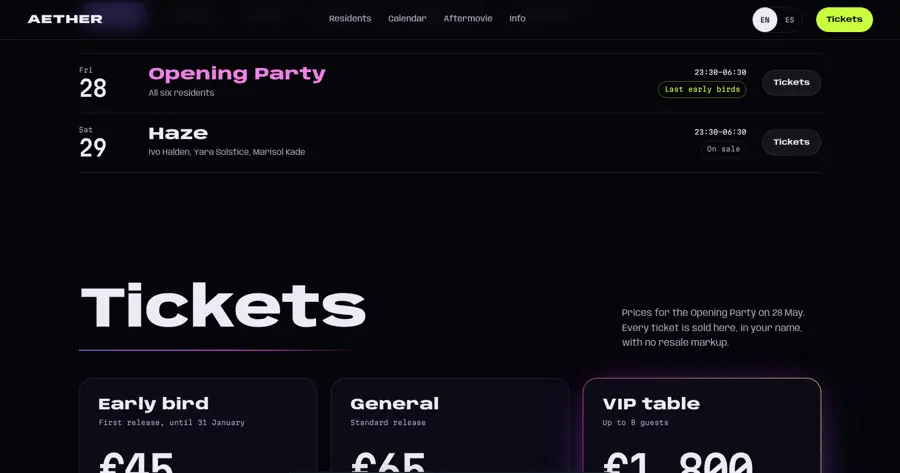
- A clear title: party name, headliner, date and venue.
- Date, opening and closing times with the day of the week. A party that starts on Saturday night and ends on Sunday morning leaves people unsure which date to buy.
- The full line-up and a lightweight video.
- Current tier price and a buy button visible on a phone without scrolling.
- Practical details: getting there from Ibiza Town, San Antonio or Playa d'en Bossa, minimum age, dress code, tables and a WhatsApp contact.
- FAQs in the page's language.
Add an events calendar linking every date of the season, from opening to closing, in order and with past events off the top spot. When a date sells out, do not delete the page: mark it sold out and point to the next one. Once it has passed, turn it into a gallery that links to the next edition, keeping whatever the page has earned in Google.
Checkout: integrated, fast and keeping your data
The most important technical decision is how your site connects to the sale. There are three models:
| Model | Pros | Cons |
|---|---|---|
| Link out to a ticketing platform | Quick to set up, no maintenance | The buyer leaves your site; often no pixels and no customer data for you |
| Embedded ticketing widget | Purchase happens on your page; a balance of effort and control | Limited to what the provider allows on pixels, languages and design |
| Your own checkout | Full control of experience, data and tracking | More development, plus a payment gateway and door scanning to maintain |
Whichever you choose, checkout must work one-handed: few fields, the payment methods international visitors use (cards and mobile wallets such as Apple Pay or Google Pay), the full price including fees from the first step and a confirmation in the buyer's language.
In Spain, many guests would rather ask a quick question on WhatsApp than read a long FAQ. A WhatsApp button on every event page, answered promptly during the season, catches buyers who would otherwise hesitate over a table, a group booking or the dress code.
Event structured data for Google
Event structured data tells Google what, when and where, and makes your event eligible for its event experience, which Google lists as available in Spain and in key Ibiza source markets such as the UK, Germany and the US. According to the documentation:
- Required: name, start date and a location with a postal address.
- Recommended: description, end date, image, performer, organiser, event status and ticket offer.
- Offer: the lowest available price including fees, availability (in stock, sold out or pre-order), the on-sale date and a URL where the public can buy a ticket for that specific event.
- Changes: if an event is cancelled or postponed, keep the start date and change the event status instead.
Google also asks you not to mark up opening hours, short-term sales promotions or vouchers as events. A residents' night is an event; a drinks discount is not.
Languages, speed and mobile
In Ibiza, half the job of a nightlife website is linguistic. English and Spanish are the minimum, each page linked to its counterpart and a language switcher that lands on the same party, not the homepage. If a large share of your crowd is Italian, French or Dutch, a properly written page in their language is worth more than a machine translation.
Speed is the other half. People buy on their phones, from a sunbed or a taxi, sometimes on a weak signal. Video and effects have their place, but they should load after the buy button and be optimised for mobile. Your Google Business Profile should link to the events calendar or the next party, not a generic homepage. To see how an immersive experience can sit alongside a sales structure, explore our nightclub demo with a WebGL light show, built for a fictional brand.
Tracking, cookies and accessibility
Without tracking you will never know which ad sells. Install the Meta and TikTok pixels with their server-side connections and the purchase event, and respect cookie consent, since advertising can only measure people who accept it. Test the purchase event every month: a ticketing update or a new cookie banner can quietly break tracking in the middle of the season. Our guide to Instagram and TikTok ads for Ibiza nightclubs goes into detail.
Accessibility is no longer optional either. Spain's Law 11/2023, which transposes the European Accessibility Act, has applied since 28 June 2025 to e-commerce services, meaning the online sale of any product or service, as law firm Cuatrecasas explains. According to Legalitas, the exception is microenterprises, with fewer than ten employees and turnover below two million euros. A club with a full seasonal team is unlikely to qualify, so check your case with your adviser.
- Every event has its own page, URL and counterpart in the other language.
- The buy button is visible on a phone without scrolling.
- Displayed prices include booking fees and VAT.
- Event structured data passes Google's Rich Results Test.
- Pixels record the purchase with its value.
- Alt text, colour contrast and keyboard navigation have been checked.
- The calendar shows upcoming dates first.
Event pages are also the backbone of pre-sale, as explained in our ticket pre-sale strategy for Ibiza events. If you are planning a new site, our web design in Ibiza page explains how we work, and nightclub marketing in Ibiza shows how it fits with campaigns.
Frequently asked questions
Should we sell tickets on our own site or through a ticketing platform?
It is rarely either-or. Most clubs use a ticketing platform for payment and door scanning, embedded in their own site through a widget or a checkout on their domain. What matters is that you can track with your own pixels, keep consented buyer data and offer checkout in several languages.
What structured data does an event page need?
Google requires the name, start date and a location with an address. It recommends a description, end date, image, performer, organiser, event status and a ticket offer with price, availability and a purchase URL. If the event is cancelled or postponed, update the status rather than deleting the date.
Does a nightclub website in Spain have to be accessible?
If it sells tickets online, very probably. Spain's Law 11/2023 has applied to e-commerce services since 28 June 2025, with an exception for microenterprises with fewer than ten employees and turnover below two million euros. Check your specific situation with a legal adviser.
Sources
Want your club full all season?
We'll give you a free strategy analysis of your business and tell you honestly what we would do, no obligation.