3D web design is no longer a party trick for gaming studios: an ordinary phone can now render a villa, an interactive floor plan or a sea that ripples under your thumb, in real time. The catch is that a badly planned effect can leave your website slower, harder to use and less visible on Google than the template it replaced.
This guide is for owners and managers of Ibiza villas, yachts, hotels, beach clubs and venues, whether you run the business from the island or from London, Munich, Amsterdam or Stockholm. It separates the hype from what actually wins bookings in 2026, shows when 3D works against you, and gives you a performance budget to agree before you sign off a single effect. Five live demos at the end let you test every point on your own phone.
Hype or value? The question to ask before paying for 3D
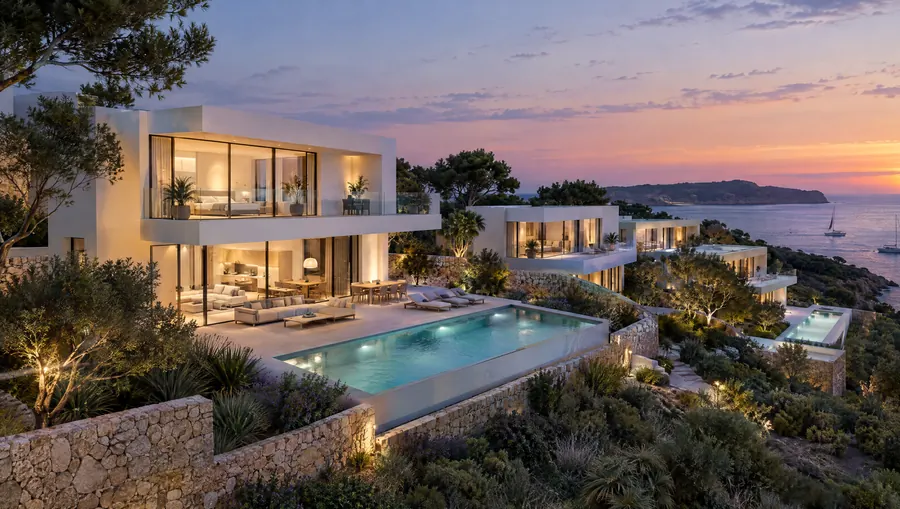
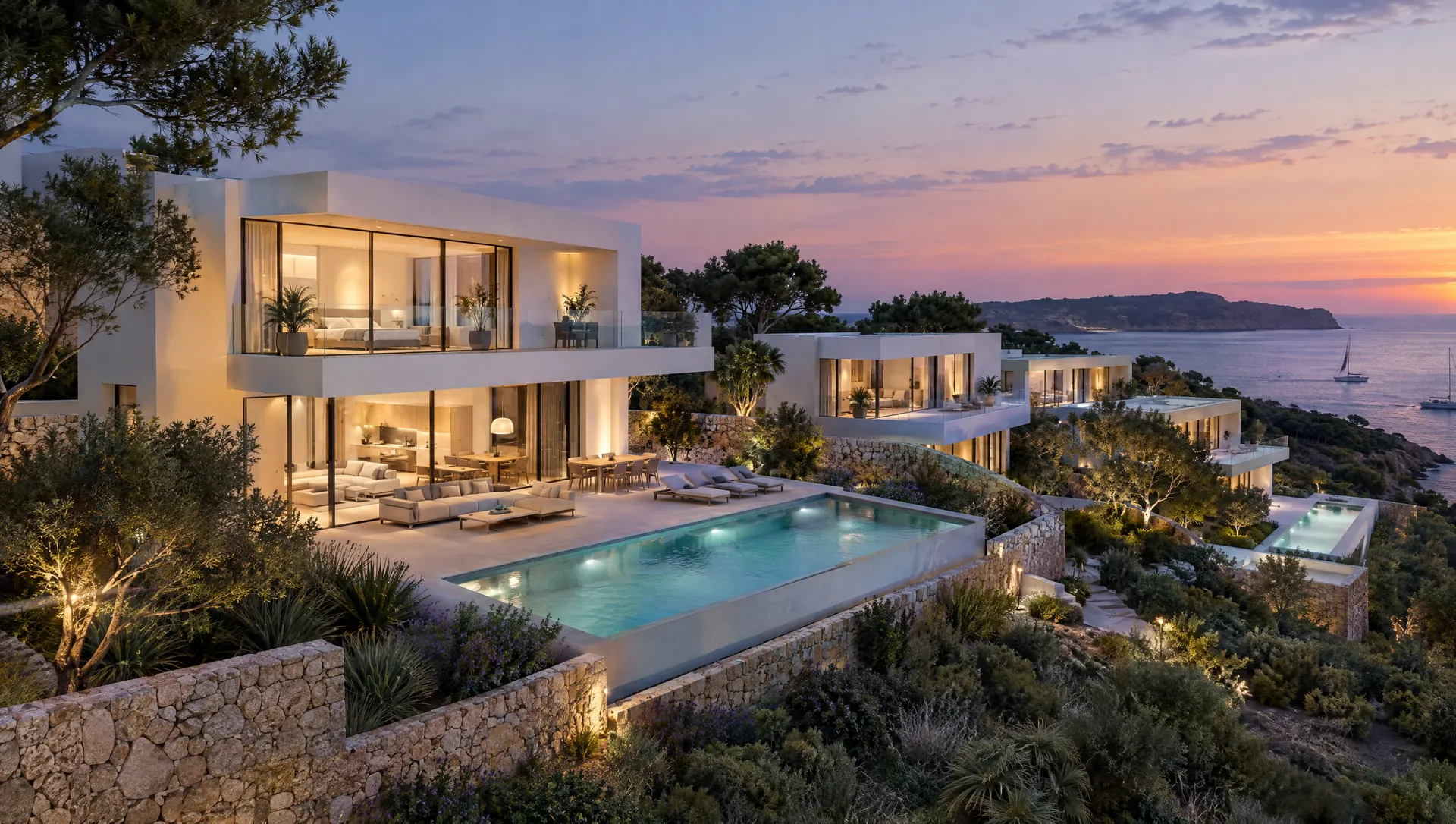
On interactive websites, 3D earns its place when it shows something a photo cannot: the volume of a house, how far the master bedroom is from the pool, how light moves across a dance floor, the route a boat will take. If it only decorates, it is a cost: more weight, more work for the phone and more reasons for someone in a hurry to leave.
In Ibiza that line matters more. Many guests and buyers decide from abroad, often on a phone, without ever having set foot on your terrace. For them, understanding a space before booking has real value; for someone hunting for your menu or WhatsApp on a Saturday in August, any animation in the way is friction. So ask one question of any 3D web design proposal: which of the guest's doubts does this effect resolve before they book, buy or request a viewing? If nobody can answer, you don't need it.
Web design trends 2026: the 3D techniques that pay their way
WebGL lets a browser draw interactive 3D graphics inside a canvas element, with no plug-ins. MDN notes that all modern browsers support it but the device also needs compatible hardware, which is why serious WebGL websites always ship a fallback.
Real-time WebGL heroes
Instead of a video, a scene generated in the browser itself: water rippling under your thumb, sunset light, beams sweeping across a dance floor. The technical detail matters: canvas is not among the elements web.dev lists for Largest Contentful Paint (images, videos and blocks of text), so the first screen should be resolved in HTML, with an optimised photo and a real headline. The scene fades in on top when ready and, if anything fails, the visitor still sees a finished page.
Interactive 3D floor plans and walkthroughs
The strongest case, for villas, new builds and yachts. A plan the guest can turn with a finger answers in seconds what a PDF takes pages to explain: which bedrooms face the sea, how the deck is laid out. For an overseas buyer weighing up a new build in Santa Eulària before flying out to view it, that clarity is the point. With the architect's plans or the shipyard's model, part of the work is done. Ask for models in glTF, the royalty-free format Khronos maintains for the efficient transmission and loading of 3D scenes.
Shader image transitions
Shaders are small programs that run on the graphics card. In a gallery, they make one photo dissolve or ripple into the next like the surface of a pool. For hotels and restaurants with strong photography, the risk is low: nothing is hidden and, without WebGL, the carousel can fall back to a normal crossfade.
Motion without heavy libraries: what browsers now do natively
The least flashy trend of 2026 may pay best: browsers now handle animations that once needed heavy JavaScript.
Scroll-driven storytelling with CSS
CSS scroll-driven animations tie an animation to scroll progress rather than to the passing of time: a floor plan that draws itself, a terrace that lights up, a route that inches towards Formentera. Chrome for Developers explains that they can run off the main thread, which was very hard with classic JavaScript scroll events. One caveat: MDN lists animation-timeline as limited availability, because it does not work in some of the most widely used browsers. Treat it as an enhancement: without it, all the content must still be there.
The View Transition API
The View Transition API animates the change between views, within a page or when navigating between pages: the photo of a villa glides from the listing into its detail page instead of a blank reload. MDN marks the same-document version (startViewTransition()) as Baseline 2025, working across the latest browsers since October 2025, while the cross-document version (@view-transition) still has limited availability and needs both pages on the same origin. Without support, the site still works, just without the animation.
Variable fonts and micro-interactions
A variable font packs weights, widths and styles into a single file which, according to MDN, is in most cases smaller than or about the same size as the four files you might load for body copy. Micro-interactions (a button that responds, a booking bar that confirms your dates) make a site feel expensive, but they must be light: Interaction to Next Paint (INP) measures how quickly a page responds to clicks, taps and key presses, and long tasks on the main thread can drag it down.
When 3D sells: sector by sector
Where luxury web design with 3D pays off, and where light motion is enough:
| Business | The doubt it resolves | Technique that fits | Must stay in HTML, in every language |
|---|---|---|---|
| Rental villas and new builds | Layout, orientation, views | Interactive 3D floor plan or walkthrough | Bedrooms, sleeps, location, viewing request |
| Yachts and charter | Space on board, atmosphere, route | Yacht model, real-time sea, route map | Length, guests, rates, departure port |
| Wedding and event venues | Capacity and set-up | Interactive plan with alternative layouts | Capacity, available dates, enquiry form |
| Clubs | The feel of the night | WebGL light-show hero | Line-up, dates, tickets, opening hours |
| Boutique hotels | How a stay feels | Image and view transitions | Rooms, rates, direct booking bar |
| Restaurants and beach clubs | What's on the menu, how to book | Micro-interactions; 3D only as a showcase | Menu, allergens, hours, booking and WhatsApp |
The last column is what Google needs to read and what a guest in a hurry wants, whether they search in English, German, Dutch or Italian. HTML text can be translated, indexed and read aloud in each language; text painted into a 3D scene cannot (see our guide to multilingual websites for Ibiza hotels and restaurants). If you sell villas in Sant Josep, a 3D floor plan may be your best salesperson; if you run a restaurant in Ibiza Town, it is a menu that loads instantly.
When 3D costs you bookings
- Menus, opening hours and directions. People want these answers now. A menu locked inside a 3D carousel turns a quick check into a wait.
- Modest phones. web.dev explains that large JavaScript files are parsed and executed on the main thread and can delay rendering even after the main image has downloaded. An unchecked 3D scene can hurt LCP and INP precisely on mid-range phones.
- Accessibility. MDN warns that a canvas is just a bitmap: what is drawn on it is not exposed to accessibility tools the way semantic HTML is. And WCAG 2.2 (Level A) requires a way to pause, stop or hide moving content that starts automatically, lasts more than five seconds and sits alongside other content.
- SEO. According to Google Search Central, Google indexes the rendered HTML, can only discover links that are <a> elements with an href attribute, and not all bots can run JavaScript. And because Google Search does not interact with your page, anything that only appears when someone spins the model or taps inside the scene is out of its reach.
A performance budget and a plan B
web.dev defines a performance budget as a set of limits imposed on metrics that affect site performance. On a 3D site, it separates indulgence from investment. The minimum is Core Web Vitals in the green: LCP of 2.5 seconds or less, INP of 200 milliseconds or less and CLS of 0.1 or less, measured at the 75th percentile of page loads, segmented across mobile and desktop. As a starting figure, web.dev suggests under 170 KB of critical-path resources, compressed and minified. In short: 3D stays off the critical path and loads after the content.
Google is clear that good scores don't guarantee top rankings, because relevant content comes first, although page experience can help when plenty of helpful content competes. What you can control is that 3D never costs you. Our checklist:
- The first screen starts with an optimised photo and a real HTML headline; that image is never lazy-loaded and carries fetchpriority="high".
- Copy, prices, opening hours and links live in real HTML, never inside the canvas.
- The 3D scene loads after the content, only when it scrolls into view.
- Animation pauses off-screen or in a background tab, and canvas resolution is capped on high-density screens.
- Without WebGL, a static version that looks finished, not a gap.
- With Reduce Motion on: no auto-playing animation or parallax, just a still frame.
- On phones, the 3D viewer is activated with a tap and never hijacks scrolling.
- Compressed glTF models with an agreed maximum weight, tested on a mid-range phone over mobile data.
Reduce Motion is the device setting a site detects through the prefers-reduced-motion media query, available across browsers since January 2020 according to MDN, which notes that scaling or panning large objects can trigger discomfort for people with vestibular motion disorders. On an iPhone it is in Settings > Accessibility > Motion; on Android, Settings > Accessibility > Remove animations. Switch it on and open the site you are being pitched: if everything still moves, the job isn't finished.
Five live demos to test on your phone
So you don't have to take our word for it, we built five concept websites for fictional Ibiza brands. They are not real clients or case studies: they are demos built by Grow Ibiza so you can try every idea in this article.
- Villa Aldara, luxury villa: an interactive 3D floor plan. See how quickly the layout makes sense, before any viewing.
- Aether Club, nightclub: a WebGL light show, a scene generated in the browser that conveys the feel of the night.
- Marea Beach Club: a 3D menu carousel and booking. 3D as a showcase for dishes; on a real site, the full menu belongs in text as well.
- Albada Hotel, boutique hotel: WebGL image transitions and a direct booking bar, so the gallery nudges guests to book direct rather than through OTAs.
- Halcyon Charter, yacht charter: a real-time 3D ocean and a route map. The sea sets the mood; the route informs.
Open them on a modest phone with Reduce Motion on.
How to decide before next season
To have 3D live for the May to October season, aim to sign the project off before Easter. The bottleneck is rarely code but the plans, the yacht model, good photography and copy in every language you sell in: gather those first.
- Write down your guest's main doubt before booking; if 3D doesn't answer it, drop it.
- Choose one hero 3D piece; for everything else, light native motion.
- Agree the performance budget and the fallback before design starts.
- Test on a phone, with Reduce Motion on and without WebGL, before going live.
- After launch, keep an eye on LCP, INP and CLS in Search Console's Core Web Vitals report.
If your current site is already slow, start there: why a slow website doesn't show up on Google walks through the diagnosis, and how much a website costs in Ibiza breaks down what drives the price. On our web design service in Ibiza, these rules apply from the first sketch.
Frequently asked questions
Does 3D web design hurt SEO?
Not in itself. The risk lies in putting copy, prices or links inside the canvas, or in content that only appears when someone interacts with the scene: Google indexes the rendered HTML and does not interact with the page. Keep the content in HTML, load the 3D afterwards without dragging Core Web Vitals down, and 3D and SEO can live together.
Will a 3D website work on my guests' phones?
It can work very well if it is designed for phones from the start: capped canvas resolution, animation paused when out of view, a tap to activate so scrolling is never blocked, and a photo fallback when the device does not support WebGL. Without those measures, 3D can drag down LCP and INP on more modest phones.
Can a 3D website work in several languages?
Yes, as long as the words live in HTML rather than inside the scene. Headings, room names, prices and buttons should be ordinary text, so each language version can be translated properly, indexed by Google and read by screen readers. Text painted into a canvas is just pixels, so every language would need its own version of the scene.
Should I ask for WebGPU instead of WebGL in 2026?
WebGPU is the successor to WebGL and unlocks more advanced graphics card features, but MDN still lists it as limited availability because it does not work in some of the most widely used browsers. For a commercial website, WebGL remains the safe foundation; WebGPU only makes sense as an enhancement with a fallback.
How much does 3D add to the cost of a website?
It depends mostly on whether a model already exists. With the architect's plans or the shipyard's model, part of the work is done; modelling from scratch costs more. Ask for 3D as a separate line in the quote, with its own weight limit and fallback, so you can judge it on its own merits.
Sources
- MDN: prefers-reduced-motion
- MDN: CSS scroll-driven animations
- MDN: animation-timeline (browser support)
- Chrome for Developers: Scroll-driven animations
- MDN: View Transition API
- MDN: Using the View Transition API
- MDN: Document.startViewTransition()
- MDN: @view-transition
- MDN: WebGL API
- MDN: WebGPU API
- MDN: The canvas element
- MDN: Variable fonts
- Khronos Group: glTF
- web.dev: Web Vitals
- web.dev: Largest Contentful Paint (LCP)
- web.dev: Optimize Largest Contentful Paint
- web.dev: Interaction to Next Paint (INP)
- web.dev: Performance budgets 101
- Google Search Central: JavaScript SEO basics
- Google Search Central: Fix lazy-loaded website content
- Google Search Central: Understanding page experience
- W3C: Understanding WCAG 2.2 Success Criterion 2.2.2 Pause, Stop, Hide
Want a new website for your business in Ibiza?
Tell us about your business and we will prepare a custom proposal, no obligation.